

In the design of automated machinery and linear motion systems, engineers must consider parameters beyond basic speed and precision. Installation constraints and component complexity are critical factors that directly impact the overall dimensions and manufacturing cost of a machine.
When specifying a linear actuator, many professionals default to a standard flanged nut design. However, for applications with strict spatial limitations, alternative configurations like the square nut ball screw BNT series (In Thai known as ‘บอลสกรู BNT‘), manufactured by THK, offer a more structurally efficient solution. This article compares the engineering differences between these two designs to assist you in making an informed, cost-effective choice for your project.
Understanding the Structural Differences
The physical shape of a ball screw nut directly dictates how it integrates into a machine’s framework. By comparing the traditional flanged design with the streamlined square nut, engineers can easily determine which configuration best optimizes their available space and mounting requirements.
Standard Flanged Ball Screw
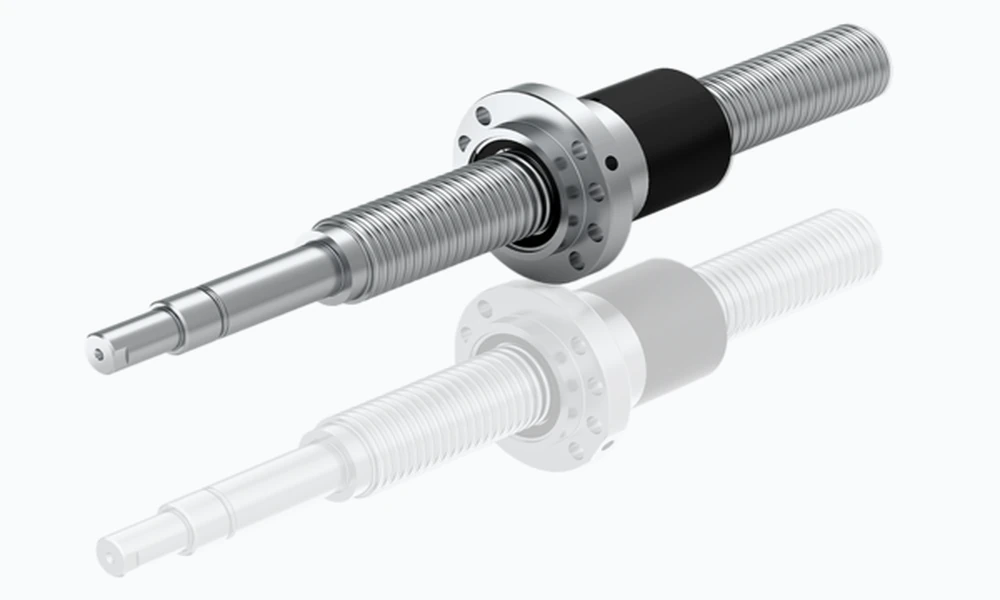
This is the most widely recognized ball screw configuration in the industry. The nut features an extending flange (either fully round or flat-cut) with through-holes for bolting it to the machine’s moving carriage.
– Advantages: It offers versatile mounting, secure fastening, high rigidity, and excellent resistance to impact loads. There is also a vast array of specifications available on the market.
– Limitations: The protruding flange requires significant radial clearance. In many structural layouts, it also necessitates the fabrication of an additional housing unit or bracket to mount the nut properly to the table.
Square Nut Ball Screw (Model BNT)
The BNT series is engineered specifically to overcome spatial constraints by redesigning the nut into a compact square block. It eliminates the flange entirely and utilizes built-in tapped holes directly on the nut body.
– Advantages: Its primary strength is its compact design. Engineers can mount the worktable directly onto the ball screw nut, completely eliminating the need for complex external housings or brackets.
Point-by-Point Engineering Comparison
To provide a clearer picture for machine integration, let’s compare their structural characteristics:
– Installation Space: Flanged models require extra clearance for the flange and its housing. The BNT model can be mounted flush against the machine structure, allowing you to downsize the equipment and achieve a cleaner, more organized layout.
– Parts Reduction: By removing the need for a separate nut housing or bracket, the BNT series not only reduces system weight but also decreases the total number of parts to purchase and significantly shortens machine assembly time.
– System Weight & Inertia: Eliminating bulky mounting accessories reduces the overall mass of the moving axis. This results in lower system inertia, allowing the motor to accelerate and decelerate with improved responsiveness.
– Preload Specifications: Flanged ball screws offer various preload options to eliminate backlash for high-precision tasks. The ball screw BNT, however, is typically designed as a rolled ball screw with no preload. It is highly cost-effective for power transmission and transport tasks that do not require micron-level positioning.
Which Applications Are Best Suited for the Ball Screw BNT?
If your project fits into any of these three categories, utilizing the Ball screw BNT can optimize both performance and cost:
1. Machinery with Severe Space Constraints
Applications such as desktop 3D printers, small electronic pick-and-place mechanisms, or automated systems where the linear drive must be hidden within tight internal cavities.
2. General Material Handling and Transport
Conveyor mechanisms, sensor positioning slides, or transfer systems that do not require ultra-high precision but demand smoother, faster, and more efficient motion than a standard lead screw.
3. Budget-Controlled Projects
Reducing the number of required structural components and simplifying the alignment process actively helps lower hidden manufacturing, machining, and assembly costs.
Standard flanged ball screws remain an excellent standard for heavy-duty machinery and cutting applications that demand maximum rigidity. However, for modern automation that prioritizes compactness, lightweight design, and simplified assembly, integrating a square nut technology like the ball screw BNT is a logical engineering choice that efficiently manages overall costs.
If you are designing a new machine or looking to optimize your linear motion system for maximum space efficiency, consult the engineering team at I.N.B. As an official authorized distributor of THK products, we are ready to help you evaluate loads, calculate dimensions, and select the precise ball screw specifications that best suit your application.
