

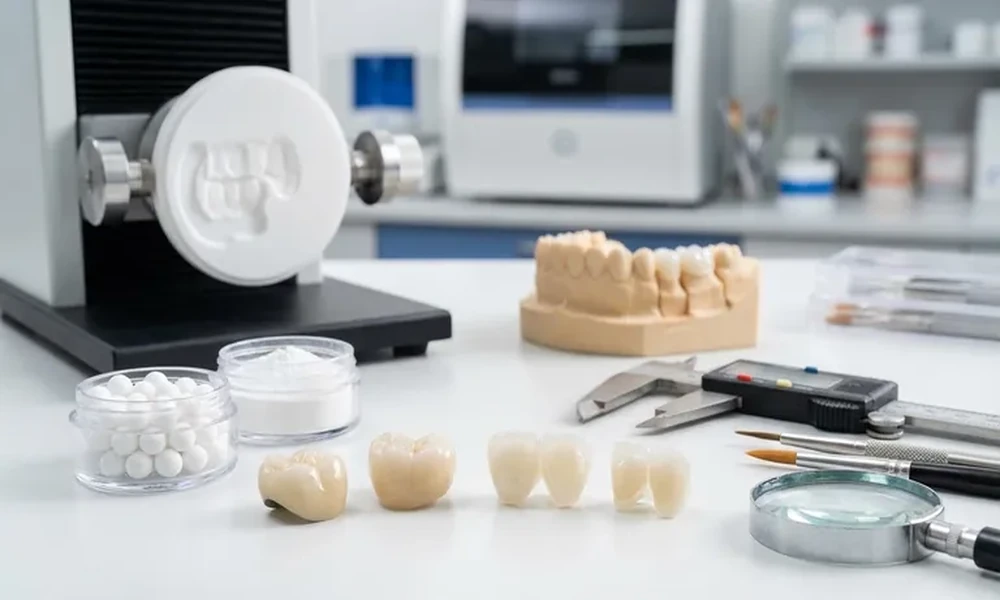
A lower first molar for a patient who grinds at night and an upper central incisor beside natural teeth can land on the same lab bench on the same morning. Both will be milled from zirconia, and they ask for nearly opposite things. The molar needs toughness above all, while the incisor has to let light pass through it the way enamel does. That split is exactly what paired product lines are built around, with Explore Esthetics dental zirconia blocks at the translucent end and a sister disc made for strength.
Labs handle the tension by stocking more than one type of disc and matching each case to the right one. Understanding why the two families behave so differently makes those daily decisions faster and cuts the number of remakes.
Why Can’t One Zirconia Be the Clearest and the Toughest at Once?
Zirconia’s strength comes from a quirk of its crystal structure. In conventional dental zirconia, most grains sit in a tetragonal form that can switch to a bulkier form when a crack starts to spread. That switch squeezes the crack closed, a process known as transformation toughening, and it explains why early zirconia frameworks survived loads that would break most ceramics.
Translucency works against this. To let more light through, manufacturers add more yttria, which produces a larger share of cubic grains. Cubic grains scatter less light, so the material looks livelier. They do not transform under stress, though, so the toughening effect drops. More light usually means less resistance to fracture, and every disc on the market sits somewhere along that line.
What Do the 3Y, 4Y and 5Y Labels on Zirconia Discs Mean?
The labels refer to the approximate amount of yttria in the material, measured in mole percent. 3Y zirconia is the classic high-strength type, mostly tetragonal and fairly opaque. 5Y has the highest cubic content of the three and the best light transmission, with a clear drop in strength. 4Y sits between them, trading a little of each. The figure says nothing about shade, so two 4Y discs from different makers can still look and behave differently once sintered, which is why labs judge each product on its own instructions and test crowns.
Manufacturers increasingly blend these grades inside one disc. A multilayer gradient disc can put a more translucent composition near the incisal edge and a stronger one toward the cervical area and the connectors, so a single restoration gets both properties where each is needed most.
Where Do Explore Esthetics Dental Zirconia Blocks Fit in a Lab’s Range?
Upcera, a Chinese dental ceramics manufacturer, makes Explore Esthetics zirconia, which appears in the company’s own catalog as Explore Esthetic. Product listings describe a multilayer disc with five gradient layers running from 4Y to 5Y composition, varying in color, translucency and strength across its height. The stated indications focus on the anterior region, including veneers, inlays, onlays, single crowns and bridges of up to three units.
In practice, a lab reaches for a disc like this when the restoration is visible and the bite is gentle: a central incisor matched to its neighbor, a set of anterior veneers, or a premolar in a patient with a high smile line. Distributor listings show A-shade versions in more than one disc height, so the shade and the height of the restoration decide which disc goes into the mill.
When Does Explore Functional Zirconia Make More Sense?
The partner product shifts the gradient toward toughness. Explore Functional zirconia is presented as a five-layer disc whose composition moves from 3Y to 4Y, with indications that start at a single full-contour crown and extend to a full-arch bridge. The 3Y content gives the cervical and connector areas the toughening that long spans depend on, while the 4Y layers bring some translucency to the visible surface.
This is the disc for molars, long posterior bridges, implant-supported full arches and patients with heavy bite forces or a history of fractured restorations. Appearance still counts, but it comes second to survival under load. Technicians who mill these cases often add a touch of external stain and a high polish to the occlusal surface, which keeps the crown looking natural in the back of the mouth without asking the material for more translucency than the case can afford.
Which Case Details Should Decide the Disc?
The choice is easier when the prescription carries the right information. Position in the mouth is the first clue: anterior teeth lean toward translucency, the territory of Explore Esthetics dental zirconia blocks and similar discs, while molars lean toward strength. Span comes next, since bridge connectors carry the highest stress and need the stronger composition. Bite history matters as much as anatomy, so a note about bruxism or a broken previous crown should push the case toward the tougher disc. That is where Explore Functional zirconia or another strength-focused grade earns its place on the shelf.
Preparation and space count too. More translucent zirconia generally needs more thickness to reach adequate strength, so a thin preparation or limited occlusal clearance can rule it out even in a visible area. The color of the underlying tooth or abutment matters as well, because a very translucent crown can let a dark stump or metal post show through. In those cases a slightly more opaque material often gives the better esthetic result, even for a lab that keeps Explore Esthetics zirconia discs on the shelf for its front-tooth work.
Finally, the minimum wall thickness and connector size printed in each product’s instructions should guide every design. Those values differ between brands and between layers, and they are the safest reference for a specific case.
Can a Lab Stock Just Two Types of Zirconia?
For most everyday work, yes. A translucent gradient disc for anterior cases and a stronger gradient disc for posterior and long-span cases cover the large majority of crowns and bridges a typical lab sees. Keeping a few common shades of each, in the disc heights the mill uses most, keeps inventory manageable without forcing compromises on difficult cases. Specialized materials can still be ordered for rare situations, such as very thin veneers or unusually long implant frameworks.
____________________________________________________________________________________________
