

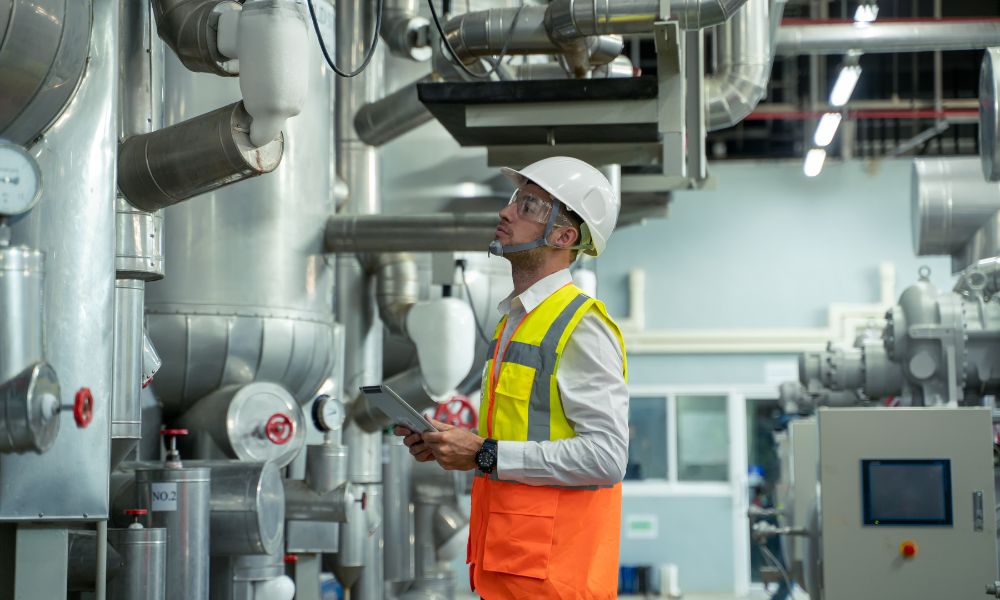
The chemical industry is entering a new era — one defined not by larger reactors or higher capacities, but by smarter, more efficient systems. As global demand for specialty chemicals, pharmaceuticals, and sustainable materials grow, manufacturers are rethinking traditional setups. Two major trends are driving this evolution: Process Intensification and Chemical Process Automation.
Together, they’re reshaping how plants operate — making production faster, cleaner, and far more adaptive to modern challenges.
What Is Process Intensification?
In simple terms, process intensification means designing chemical processes that achieve more with less — less space, less energy, and less waste. Instead of scaling up, engineers are now “scaling smart.”
Traditionally, large-scale production relies on huge reactors, extensive piping, and high resource consumption. Process intensification changes that by introducing compact, highly efficient systems that boost mass and heat transfer rates.
Some common examples include:
- Microreactors that accelerate reactions by improving surface contact between reactants.
- Continuous flow reactors that replace large batch processes with streamlined consistent operation.
- Integrated heat exchangers that recover and reuse thermal energy within the system.
The result? Smaller footprints, faster reactions, and greener production — all without compromising yield or quality.
Why Process Intensification Matters Now
As environmental standards tighten and raw material costs rise, industries are under pressure to do more with fewer resources. Process intensification is emerging as the answer because it delivers efficiency on multiple fronts:
- Energy Savings: Improved heat exchange and reaction kinetics significantly reduce energy use.
- Reduced Equipment Size: Compact designs free up valuable floor space and lower installation costs.
- Faster Reaction Times: Enhanced mixing and mass transfer shorten reaction cycles dramatically.
- Improved Safety: Smaller inventories and controlled environments minimize risks of leaks or runaway reactions.
- Sustainability: Optimized processes generate less waste and consume fewer raw materials, aligning with global green manufacturing goals.
In industries like fine chemicals, pharmaceuticals, and polymers, these benefits directly translate to cost competitiveness and faster time-to-market.
The Role of Chemical Process Automation
While process intensification focuses on the physical and chemical side of operations, chemical process automation brings intelligence to control, monitoring, and decision-making.
Modern automation systems integrate sensors, PLCs, SCADA, and AI-driven analytics to maintain consistent quality, detect anomalies, and adapt in real time. This digital backbone ensures that intensified processes operate at their full potential.
Here’s how automation enhances modern plants:
- Real-Time Monitoring: Continuous data from pressure, temperature, and flow sensors ensures instant visibility across systems.
- Predictive Maintenance: Algorithms detect performance drifts or potential failures before they disrupt production.
- Optimized Control Loops: Automation provides precise control over reaction conditions for repeatability and safety.
- Data-Driven Decisions: Historical and live data help engineers fine-tune parameters for maximum efficiency.
In short, automation converts intensified systems into smart, self-correcting units capable of learning and evolving over time.
Process Intensification + Automation: A Perfect Partnership
The true potential of modern chemical manufacturing lies in combining both approaches. When process intensification designs are paired with chemical process automation, plants achieve unparalleled agility and efficiency.
Imagine a flow reactor that automatically adjusts feed ratios based on reaction kinetics, or a compact distillation system that self-regulates temperature to save energy. These are not futuristic ideas — they’re happening today.
Together, these technologies deliver:
- Higher Throughput: Continuous operation replaces downtime-heavy batch cycles.
- Better Consistency: Automated feedback ensures that every production run meets tight specifications.
- Safer Environments: Real-time control reduces human error and enhances emergency response.
- Sustainable Performance: Smart systems optimize resource use and minimize emissions.
This integration marks the shift from traditional, static operations to dynamic, data-driven ecosystems.
Industries Leading the Change
Sectors such as pharmaceuticals, agrochemicals, and specialty polymers are already adopting these innovations to boost productivity and flexibility.
For example:
- Pharmaceutical companies use intensified microreactors for faster synthesis and higher purity yields.
- Chemical manufacturers apply automation to continuous flow systems for 24/7 monitoring and precision control.
- The energy and fuel sectors leverage modular intensified units to improve conversion rates and reduce carbon footprints.
These early adopters are setting new benchmarks for operational efficiency and sustainability.
The Future of Smarter Chemical Plants
As global competition and sustainability pressures intensify, the combination of process intensification and chemical process automation will define the next generation of chemical plants.
Expect to see:
- Fully autonomous micro-plants capable of self-optimization.
- Cloud-based control systems provide multi-site visibility.
- Integration of AI and digital twins for predictive simulation and remote troubleshooting.
- Modular setups that can be quickly reconfigured for new product lines.
The future isn’t about scaling up — it’s about scaling intelligently.
Final Thought
Chemical plants are no longer just factories; they’re evolving into smart, adaptive ecosystems. With process intensification driving efficiency, chemical process automation ensuring precision, and Continuous Flow Manufacturing enabling consistent scalability, the industry is stepping into an era of sustainable innovation.
Faster reactions, safer operations, and smarter control — that’s the formula defining the future of chemical manufacturing.
